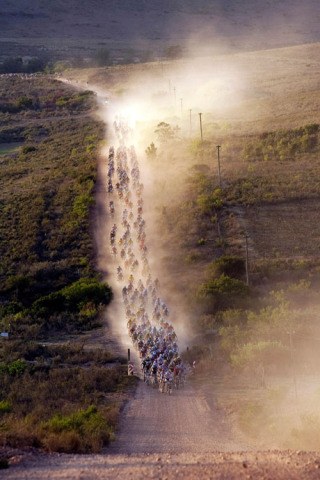
Islander DJ Brooks recently completed the grueling 2009 Absa Cape Epic mountain bike race in South Africa in March. The eight-day stage race crosses the Western Cape of South Africa at the very southern tip of the continent. It was arduous. But the story Brooks tells involves joy and adventure, not suffering or hardship.
The 450-mile race wound along dusty trails, rocky tracks, some paved roads through tiny villages and farms, and up and over mountains. In some places, the only way to continue was to push or carry your bike.
The organizers call it the “Tour de France” of mountain biking. But unlike the Tour de France, amateurs can participate alongside the pros. This year, after applications from 10,000 aspirants, 600 teams of two started the race. Brooks secured his spot in the race after he volunteered at last year’s race with his wife, Renae. They worked at the water stations and slept in the tents alongside the riders.
Brooks and his wife, Renae, have done some semi-serious cycling together in the past. They celebrated their 50th birthdays last fall by cycling 50 times around the Island.
The race started just outside the city of Cape Town in the foothills of Table Top Mountain.
Being at the starting line crammed with hundreds of cyclists was exhilarating but intimidating, Brooks said.
The first day, or the prologue, serves as a seeding tool; faster teams get to start Stage 1 at the front of the peloton.
“The energy at the start line is amazing,” he said. “But, there is dread about how hard the day will be.”
And it was.
Stage 1 was a 73-mile cross country race over three mountain ranges with over 9,000 vertical feet of climbing. “It was the hardest day I’ve ever experienced on a bicycle,” said Brooks, who has been mountain biking seriously since 2003.
Brooks, 50, grew up near Burien and White Center. He lived outside of the United States for many years in Tokyo, London and Sydney, where he worked as an investment banker. He and his wife bought a house on the Island in 1996, and their three children went to high school on the Island. Brooks no longer works, saying he saved carefully and did well in banking. He spends much of his winters now in Australia, eager to be away from the rain.
Brooks bought a “nice” road bike in 1998 and it went from there. He has been competing in endurance sports since 2002, when he started doing adventure racing in Australia. “That’s even crazier,” he pointed out. “Twenty-four hours [a day over several days] of biking, trail running, kayaking, rappelling, all while navigating to checkpoints and without stopping.”
Brooks said that he assures his success by dedicated training, but most importantly by teaming with professionals.
“Riding with a partner has many advantages,” Brooks said, both for motivation and learning. “I want to hang around with people who make me better.”
Brooks’ partner in the Epic was a friend from Australia, Tom Landon-Smith, 39. Yet his usual riding partner for these types of races is Landon-Smith’s wife, Alina McMaster. McMaster, 40, is a former Australian champion in cross country skiing. She has won every major multi-sport race in Australia and has competed in many international adventure races, including top five finishes in Eco-Challenge events and the Southern Traverse. Brooks and McMaster completed a seven-day stage race in Canada, crossing the Rocky Mountains, and were set to cycle the Epic. But a few months before, McMaster found that she and Landon-Smith were expecting their first child. Landon-Smith is no slouch himself, a former alternate for the Australian Olympic Team and winning many similar prestigious events.
“They are studs,” said Brooks, offering his highest praise. “And good friends.”
Besides the challenges of the terrain, race partners must stay within 100 meters of each other. Race officials tracked the cyclists by laying a series of electronic mats along the course to pick up the signals from electronic chips that each rider carried.
“So, Tom kept an eye out for me, always looking back, or we would ride side by side, Brooks explained. “Generally, I tried to ‘stay on his wheel’ to get the draft effect.”
The climbing was hard, he said. You wouldn’t expect South Africa to have so many mountains.
The endless climbing required careful pacing and mental strength. But the suffering was broken by periods of joy and exhilaration.
“It was fantastic to ride through the small villages. The children were always curious and wanted to high-five us or get some candy. I think they were generally proud that such a big race was going through their village.”
At one point, the peloton rode by an elementary school which had just let out. “The school children were going crazy as we rode by. We felt like rock stars,” the cyclist said.
Each evening, racers stayed overnight in huge tent cities on the edge of towns where stages finish. The atmosphere was chaotic but celebratory, Brooks said.
“All sorts of different languages were spoken. You were elated because you just finished a hard stage; exhausted and very busy getting ready for tomorrow; and there were people and stuff everywhere.”
Although the twosome did not see as much wildlife as they had hoped, they did see a lone wildebeest during Stage 5. Even as the wild animal came alongside the cyclists, the riders did not alter their course. The wildebeest galloped alongside for about 50 meters and then abruptly turned away, Brooks said.
At the finish, the pair, wearing bib numbers 3941-1 and 3941-2, had ridden over 450 miles across South Africa, climbed almost 50,000 feet, and spent 49 hours and 58 minutes in the saddle.
“I also lost six pounds,” Brooks said with a smile.