Vote no on Prop. 1 in Mercer Island | Commentary
Published 10:01 am Tuesday, September 30, 2025
With the 2023 decision by Mercer Island City Council to condemn the existing City Hall, coupled with a long-range review of capital facilities, the council embarked upon a multi-year journey to design and construct new facilities.
The council acquired a $9M 21,000 square foot building next door to the existing city campus and authorized a multimillion-dollar upgrade to the public works building extending its life to 2032. These actions give the council time to evaluate the way they do business in this fast-changing world of remote work and artificial intelligence.
Did the council do this?
No! This project started by asking each of the department heads what they “need” or believe they will need for another fifty years. This quickly turned into a very extensive wish list that includes many features more properly classified as “wants” rather than what is required for the efficient provision of essential city services. Of course, the architects hired for the job don’t want to disappoint and with a fee schedule based on cost of construction. They have no incentive to suggest right-sizing according to the realistic needs of our mature community.
Moreover, the council’s design process was exactly the opposite of how families and businesses approach large purchases. When we buy our homes, we first look at our savings and what we think we can afford in terms of down payment, mortgage payments, taxes, insurance and maintenance. There is always a nicer home exceeding this budget. We try to hold to our self-imposed budget.
Indeed, former Council member Jake Jacobsen as early as May 21, 2024 (AB6477), sensed the direction of the process by warning that the “appetite of our citizens for a gold-plated building may be limited.” The critical median household financial impact per month was first discussed only three months ago (AB6715). Well after the die was cast with the inertia of 36 regular and executive council meetings taking around 23 hours. Recently, I warned, “Mercer Island City Council, Please Slow Down,” (Letter to the Editor, Mercer Island Reporter, June 2025). In that letter I asked, “What does a $103 million bond cost Mercer Island taxpayers?”
Indeed, it’s not 20/20 hindsight to say the council should have had their “last meeting first.” They should have engaged the community (and the school district) to determine the “appetite” for a local city property tax increase. They had the hard election data from the city’s 2018 Excess Levy defeat (26% first year / 45% at the end of six-year city property tax increases) and the recent 2025 MI school bond defeat (40% local school property tax increase) to do the analysis. With this history, the council is indeed very bold to ask Islanders for a 46% city property tax increase for a building far exceeding “needs.”
Ideally the city would include the city bond’s impact on a soon to follow slimmed down school district bond. Only after ascertaining a budget based on the median household tax increase should the city council enter into discussions with architects.
Now we’re voting on a design that will cost residents a 46% increase in their 2026 city property taxes. Over the 25-year term, Islanders will pay $174 million when interest charges are included. Strangely enough, the ordinance you are voting on gives the city a blank check by authorizing, “costs of the project, which are estimated to be more than $103,160,000, will be paid from proceeds of the bonds authorized herein and other available funds of the city.” So how much is the $103 million project really going to cost? Remember, the 2017 South End Fire Station exceeded its budget by 19% (AB5247 and 5278).
By the numbers: The new facility compared to what it replaces is 80% larger, increases MIPD staffing by 41%, expects 62% more police vehicles, adds eight climate-controlled maintenance parking spots, two additional maintenance bays, and full covered parking in the temperate NW? Let alone covered parking for 140 vehicles, 30 more than what is “needed.” 200% more storage to include 556% more covered storage. A desk for every maintenance worker?
Ask yourself, why are so many organizations downsizing their office footprint per employee, yet our design increases? The design even goes against our Trip Reduction Plan (AB6630). Rather than build on unrealistic growth assumptions, the smarter approach is to build to meet today’s needs. The smaller footprint gives future leaders flexibility to adjust, expand or incorporate the dynamic changes happening today with a professional workforce.
I urge you to Vote NO. Islanders deserve a better design than the one proposed by Prop 1. Go to https://www.miforss.com/2025-city-bond/ to see our proposal.
Mike Cero of Mercer Islanders for Sustainable Spending authored this opinion article and also authored the statement in favor of Prop. 1 that is found in the King County Elections voters pamphlet.
–
About Mercer Island’s Public Safety and Maintenance Facility Bond
In the Nov. 4 general election, Mercer Island voters will decide on Proposition 1, the Public Safety and Maintenance Facility Bond.
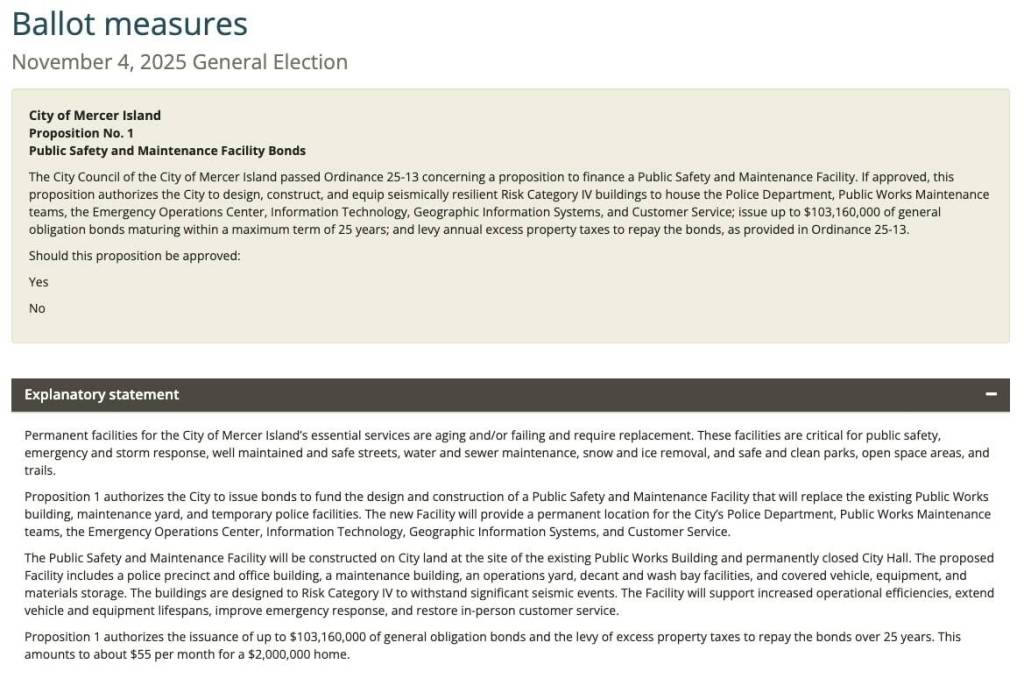
According to an explanatory statement in the King County Elections voters pamphlet: Proposition 1 authorizes the city to issue bonds to fund the design and construction of a Public Safety and Maintenance Facility that will replace the existing public works building, maintenance yard, and temporary police facilities. The new facility will provide a permanent location for the city’s police department, public works maintenance teams, the emergency operations center, information technology, geographic information systems and customer service. Proposition 1 authorizes the issuance of up to $103,160,000 of general obligation bonds and the levy of excess property taxes to repay the bonds over 25 years. This amounts to about $55 per month for a $2,000,000 home.
The Mercer Island Reporter reached out to the pro and con committees to author these statements about the bond. Both sides were offered a limit of 750 words.