
Vote yes on Prop. 1 in Mercer Island | Commentary
Published 10:05 am Tuesday, September 30, 2025
Voters on Mercer Island deserve information that is correct so that they can make informed decisions that affect the community’s public safety and the delivery of public services through the city’s public works department and its emergency operations center. We are writing this letter to you to ensure that misleading information does not form the basis of your decision-making. Too much is at stake.
Proposition 1, which received unanimous support from our city council, is the best and most cost-effective way to address the community’s critical needs related to public safety and the delivery of public services. The design of the proposed Public Safety and Maintenance Facility was by qualified and experienced architects and engineers over time with the input of our city council, city staff, and public.
Rather than build a modern, safe and effective facility that will house our critical workers, those attacking Proposition 1 appear to be content with paying substantial sums to continually repair a decaying, asbestos laden building that will need to be replaced for far more money later on. Kicking the can down the road is not an effective strategy. And while the can is being kicked, we are all less safe. Those against Proposition 1 rightly point out that the tax increase will be 46%. What they don’t say is what the cost will be to our community by delaying action. It will be substantial. In short, we will wind up paying more over time while the delay creates less than safe and ideal working conditions for our first responders and city employees.
The reason the tax hike percentage sounds high is because Mercer Island taxes are relatively low in comparison to other communities. Even after the tax hike, Mercer Island will be around the mean regarding taxes while providing better services than other communities. And, while the total payout of $174 million sounds high, it is over 25 years, during which time the dollar will substantially erode in value. A dollar paid 25 years from now is worth much less than a dollar paid today.
Finally, the suggestion that the city can use its fund balance to reduce construction costs and the amount of Proposition 1 bonds is plainly wrong and would be fiscally irresponsible. The city’s fund balance is necessary to meet its ongoing operating expenses and not to help finance these much-needed Proposition 1 capital improvements.
If you want more correct information before making your decision, go to – https://conta.cc/46ihqis and to https://letstalk.mercergov.org/municipal-facility-planning
In short, we support Proposition 1 not because we want to pay higher taxes, but because in both the short run and long run it is a better and necessary deal for our entire community.
Russel Federman, Robert Sulkin and Benson Wong authored this opinion article and also authored the statement in favor of Prop. 1 that is found in the King County Elections voters pamphlet.
–
About Mercer Island’s Public Safety and Maintenance Facility Bond
In the Nov. 4 general election, Mercer Island voters will decide on Proposition 1, the Public Safety and Maintenance Facility Bond.
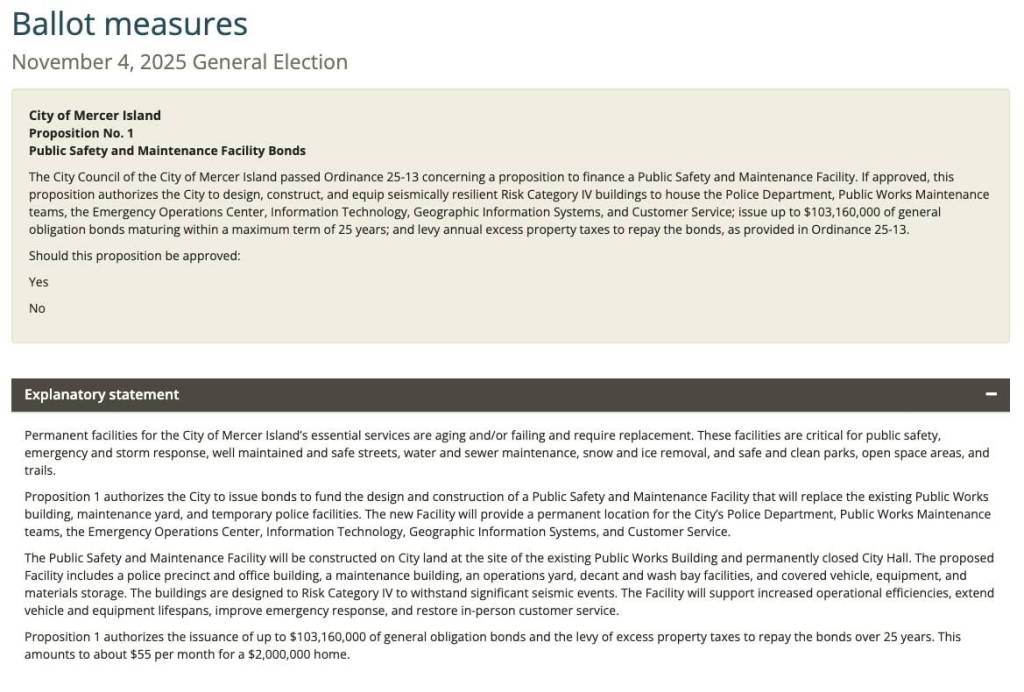
According to an explanatory statement in the King County Elections voters pamphlet: Proposition 1 authorizes the city to issue bonds to fund the design and construction of a Public Safety and Maintenance Facility that will replace the existing public works building, maintenance yard, and temporary police facilities. The new facility will provide a permanent location for the city’s police department, public works maintenance teams, the emergency operations center, information technology, geographic information systems and customer service. Proposition 1 authorizes the issuance of up to $103,160,000 of general obligation bonds and the levy of excess property taxes to repay the bonds over 25 years. This amounts to about $55 per month for a $2,000,000 home.
The Mercer Island Reporter reached out to the pro and con committees to author these statements about the bond. Both sides were offered a limit of 750 words.