
Werner Samson | Obit
Published June 12, 2026
Werner Edgar Samson
May 5, 1928 – May 4, 2026
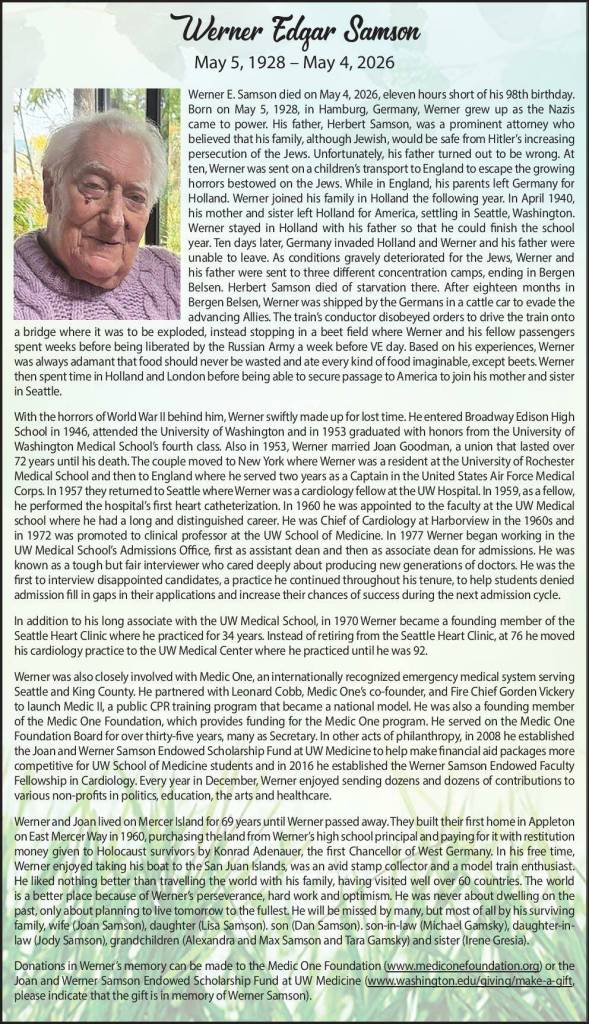
Werner E. Samson died on May 4, 2026, eleven hours short of his 98th birthday. Born on May 5, 1928, in Hamburg, Germany, Werner grew up as the Nazis came to power. His father, Herbert Samson, was a prominent attorney who believed that his family, although Jewish, would be safe from Hitler’s increasing persecution of the Jews. Unfortunately, his father turned out to be wrong. At ten, Werner was sent on a children’s transport to England to escape the growing horrors bestowed on the Jews. While in England, his parents left Germany for Holland. Werner joined his family in Holland the following year. In April 1940, his mother and sister left Holland for America, settling in Seattle, Washington. Werner stayed in Holland with his father so that he could finish the school year. Ten days later, Germany invaded Holland and Werner and his father were unable to leave. As conditions gravely deteriorated for the Jews, Werner and his father were sent to three different concentration camps, ending in Bergen Belsen. Herbert Samson died of starvation there. After eighteen months in Bergen Belsen, Werner was shipped by the Germans in a cattle car to evade the advancing Allies. The train’s conductor disobeyed orders to drive the train onto a bridge where it was to be exploded, instead stopping in a beet field where Werner and his fellow passengers spent weeks before being liberated by the Russian Army a week before VE day. Based on his experiences, Werner was always adamant that food should never be wasted and ate every kind of food imaginable, except beets. Werner then spent time in Holland and London before being able to secure passage to America to join his mother and sister in Seattle.
With the horrors of World War II behind him, Werner swiftly made up for lost time. He entered Broadway Edison High School in 1946, attended the University of Washington and in 1953 graduated with honors from the University of Washington Medical School’s fourth class. Also in 1953, Werner married Joan Goodman, a union that lasted over 72 years until his death. The couple moved to New York where Werner was a resident at the University of Rochester Medical School and then to England where he served two years as a Captain in the United States Air Force Medical Corps. In 1957 they returned to Seattle where Werner was a cardiology fellow at the UW Hospital. In 1959, as a fellow, he performed the hospital’s first heart catheterization. In 1960 he was appointed to the faculty at the UW Medical school where he had a long and distinguished career. He was Chief of Cardiology at Harborview in the 1960s and in 1972 was promoted to clinical professor at the UW School of Medicine. In 1977 Werner began working in the UW Medical School’s Admissions Office, first as assistant dean and then as associate dean for admissions. He was known as a tough but fair interviewer who cared deeply about producing new generations of doctors. He was the first to interview disappointed candidates, a practice he continued throughout his tenure, to help students denied admission fill in gaps in their applications and increase their chances of success during the next admission cycle.
In addition to his long associate with the UW Medical School, in 1970 Werner became a founding member of the Seattle Heart Clinic where he practiced for 34 years. Instead of retiring from the Seattle Heart Clinic, at 76 he moved his cardiology practice to the UW Medical Center where he practiced until he was 92.
Werner was also closely involved with Medic One, an internationally recognized emergency medical system serving Seattle and King County. He partnered with Leonard Cobb, Medic One’s co-founder, and Fire Chief Gorden Vickery to launch Medic II, a public CPR training program that became a national model. He was also a founding member of the Medic One Foundation, which provides funding for the Medic One program. He served on the Medic One Foundation Board for over thirty-five years, many as Secretary. In other acts of philanthropy, in 2008 he established the Joan and Werner Samson Endowed Scholarship Fund at UW Medicine to help make financial aid packages more competitive for UW School of Medicine students and in 2016 he established the Werner Samson Endowed Faculty Fellowship in Cardiology. Every year in December, Werner enjoyed sending dozens and dozens of contributions to various non-profits in politics, education, the arts and healthcare.
Werner and Joan lived on Mercer Island for 69 years until Werner passed away. They built their first home in Appleton on East Mercer Way in 1960, purchasing the land from Werner’s high school principal and paying for it with restitution money given to Holocaust survivors by Konrad Adenauer, the first Chancellor of West Germany. In his free time, Werner enjoyed taking his boat to the San Juan Islands, was an avid stamp collector and a model train enthusiast. He liked nothing better than travelling the world with his family, having visited well over 60 countries. The world is a better place because of Werner’s perseverance, hard work and optimism. He was never about dwelling on the past, only about planning to live tomorrow to the fullest. He will be missed by many, but most of all by his surviving family, wife (Joan Samson), daughter (Lisa Samson). son (Dan Samson). son-in-law (Michael Gamsky), daughter-in-law (Jody Samson), grandchildren (Alexandra and Max Samson and Tara Gamsky) and sister (Irene Gresia).
Donations in Werner’s memory can be made to the Medic One Foundation (www.mediconefoundation.org) or the Joan and Werner Samson Endowed Scholarship Fund at UW Medicine (www.washington.edu/giving/make-a-gift, please indicate that the gift is in memory of Werner Samson).