
Keiko journeys to the past in new book
Published 11:23 am Tuesday, December 1, 2015
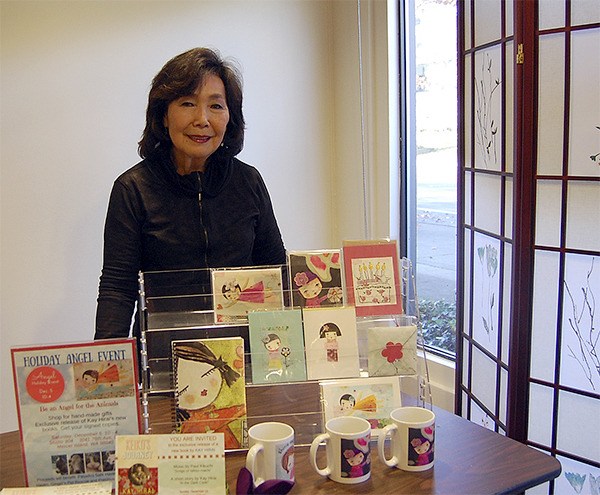
“Keiko’s Journey” is, at its heart, about a little girl and a little dog, said author Kay Hirai. But it’s also about war, isolation and the strength of Hirai’s mother, Fujiye, who died from tuberculosis when Hirai was 28.
“Keiko has been on my mind for a long time, because I wanted to tell the story of my mother,” said Hirai, owner of Studio 904 on Mercer Island.
Hirai grew up in Japan at the end of World War II, a time shrouded in secrets, she said. Her father died while serving in the Japanese Navy when Hirai was six months old, and she didn’t find out about him until moving to the United States when she was 11, in 1951.
Her mother remarried when Hirai was young, and the father she knew was a stranger, who also went off to war and returned when Hirai was six. He was abusive and jealous, but her mother remained resilient, Hirai said.
The thing that helped Hirai through a difficult childhood of bullying and domestic violence was a dog named Shiro, a terrier puppy given to her by an American solider.
“She was so fiesty,” Hirai said. “She became my best friend.”
Hirai lived in Kokura, the site of one of Japan’s largest munitions plants.
“They wanted to bomb my town after Hiroshima, but they couldn’t get a clear view,” Hirai said. “So they got instructions to drop a bomb on a city to the south, on Nagasaki.”
 After the war, Hirai became a student and entrepreneur. She loved her education in Japan, which focused on discipline and the arts: drawing, poetry, calligraphy and writing. When she was done with her homework, she set up little stores where her friends would shop, exchanging fake money for colored water or bean bags that Hirai had made.
When she moved to the U.S., settling in Renton, she didn’t know a word of English, despite her mother being an American citizen and a translator after the war. Her mother had lived on a farm in Auburn, until going to live with extended family in Japan when she was 24. Upon returning to the U.S., she reunited with family members who had been in internment camps.
Hirai struggled to adapt to American culture, becoming shy and unsure of where she belonged. She was asked to change her name from Keiko to Kay.
Things turned around when her artistic skills were noticed, after she brought her water color set to school instead of crayons.
But she put away artistic ambitions to care for her frail mother, deciding to enroll in cosmetology school instead of college and in the process, discovering a lifelong passion and opening Studio 904.
“Now, I have so much energy and I feel very fulfilled and happy. I love this business and I still love doing hair,” she said. “But I still have so many things I want to learn.”
Hirai’s enterprising spirit and belief in Kaizen, a Japanese word that means life-long learning in small incremental steps, led to the eventual success of her business, which has been on the Island for 19 years.
A multi-talented artist and perpetual student, Hirai is now learning about graphic design and technology, forming her own marketing department for Studio 904. The salon has become known for its hiring practices, employee training and community outreach programs.
In writing “Keiko’s Journey,” Hirai said she found out many things not just about her famiy, but also about herself. She said she learned to “overcome the past and live a life of purpose.”
“I feel like I was spared a life,” she said. “I shouldn’t even be here, because of the bombing. That’s why I want to help people.”
She also traveled back to Japan before writing the book. After moving to the U.S., she and her mother “erased Japan,” she said.
But when Hirai found a small gray suitcase that her mother had saved filled with letters from home, the memories started to come back. She decided to visit her father’s family, and her stepfather.
Friends and coworkers of Hirai say she is creative, compassionate and courageous.
The salon gives free haircuts to those helped by Mercer Island’s Youth and Family Services. It has many raffles and fundraisers, including the Angels for the Animals event that runs through Dec. 5, benefitting dog havens and pet rescues.
Hirai said her values come from two cultures, and that she learned different lessons from growing up in Japan and the U.S.
“For everybody who thinks they don’t have a gift to offer, look at your childhood. It’s amazing how those things come out,” Hirai said. “I’m fortunate to have two cultures to draw from.”
“Keiko’s Journey” isn’t Hirai’s first book. “Yumi’s Life Lessons,” self-published about 10 years ago, is also about the love between dogs and their owners. Hirai said she wrote it to help promote humane treatment of animals, and motivate others to help animals that need love and attention.
“Keiko’s Journey” is more about teaching people, especially children, “never to be ashamed of your origin,” Hirai said.
For more, visit keikokayhirai.com/keikos-journey.