Parties share blame in accident
Published 4:00 pm Monday, November 24, 2008
City, driver, pedestrian contributed to incident
By J. Jacob Edel
Mercer Island Reporter
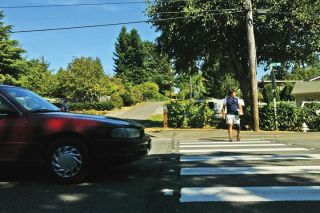
A man hit in a crosswalk on Island Crest Way two years ago was awarded damages by a jury that held the city partially liable in county court last week.
The 12-person jury found the city negligent but just 16 percent liable for the injuries and damages to Steve L. Ybarra when he was struck by a car on the crosswalk in the 4200 block of Island Crest Way in June 2005. However, the jury also found that Ybarra was culpable for the accident.
Ybarra sued the city, alleging it was negligent to improve the safety of the crosswalk in the 4200 block of Island Crest Way. The city will have to pay Ybarra $22,000.
“The system worked,” Ybarra said after the judge read the jury’s decision. “Now we can get the city to fix [the crosswalk], which is what we always wanted. We didn’t care about the money.”
Ybarra, who lives at 4240 83rd Ave. S.E. with his wife and children just south of the crosswalk, wants the city to add a flashing light or pedestrian island in the roadway to make the crosswalk safer. It is the only crosswalk in the four lane portion of Island Crest Way.
On June 17, 2005, a vehicle driven by an elderly man struck Ybarra while he was crossing Island Crest Way around 3 p.m. Albert Davis, the man who hit Ybarra, died a year after the accident and his wife reached a separate settlement with Ybarra. The city, however, denied the negligence charges and any responsibility of the accident, stating it investigated the crosswalk and deemed in reasonably safe.
During the trial, Patrick Yamashita, the city engineer, testified the city made the crosswalk safer in recent years by changing the markings from perpendicular bars to the piano key style that is there today. The city also used a reflective paint, installed reflectors in the roadway on both sides and changed the color of the advanced warning signs from the traditional yellow color to a more visible fluorescent green.
Attorney Steve Thorsrud represented the city. During the trial, the city called an accident reconstruction expert who testified Ybarra caused the accident. John Hunter is an accident reconstruction expert and was hired by the city to conduct an investigation of the cause of the collision. Hunter told the jury that his job is to determine causation and he determined Ybarra was at fault.
Hunter said he analyzed the skid marks left on the road from Davis’ car and concluded Davis did not have enough time — less than two seconds — to stop while traveling around 28 mph.
“The pedestrian caused the collision by not giving the driver enough time to stop,” said Hunter, who stated he has more than 35 years of accident reconstruction experience.
Ybarra’s lawsuit claimed the city had done nothing to correct the unsafe conditions the crosswalk. In response to Ybarra’s claims, the city countered it was he who acted negligently in his use of the crosswalk and that Davis was negligent in failing to yield to the pedestrian.
“In the end, it’s the responsibility of the driver and the pedestrian to be safe,” Yamashita said from the stand last week. “Especially in crosswalks. Make sure you have eye contact before you enter the street.”
In a written statement, one witness of the accident stated that Ybarra “aggressively” entered the crosswalk in heavy traffic. Paul Schuman, an Island resident, passed Ybarra seconds before he entered the crosswalk and watched the accident occur in his rearview mirror.
Schuman stated in court documents that he thought Ybarra was crazy for entering the crosswalk when he did.
“I thought to myself, ‘Why is he standing so close? It makes me nervous even if I slam on my brakes. I can’t stop in time,’” Schuman stated. “His lean forward was aggressive enough that I tapped my brakes and instinctively moved the steering wheel left. My initial reaction was, ‘what is this guy doing, crossing the street like that - he must be nuts.’”
Ybarra filed a separate lawsuit against Schuman, claiming a lane change caused the accident. The judge, Michael Downing, denied Ybarra’s request to conjoin the lawsuits of Schuman and the city.
In his statement to police, Schuman denied having changing lanes and insisted he remained in the curb lane the entire time. The city also claimed witness student Hannah Huang, who was 15 at the time, was waiting to use the same crosswalk from the other side of Island Crest. Court documents state that Huang did not indicate a vehicle changed lanes shortly before the accident.
During the trial, Ybarra’s wife, Kelli, testified her husband was “miserable” for at least eight months after the accident. Ybarra suffered a knee injury and severely scraped the entire left side of his body. His shoulder was also injured in the accident.
“He was miserable,” Ybarra’s wife said. “He’s an active guy, a fisherman and tug boat guy. He couldn’t do anything for eight months and even today he has a hard time dealing with what he normally used to do. His quality of life is not the same.”
Kelli Ybarra also testified that since moving to their home near Island Crest Way in 1982, she has witnessed several accidents and even more close calls in the crosswalk.
“There’s been two rear-end collisions while I was in the crosswalk,” Kelli Ybarra said. “They stopped for me to cross. I’ve also seen so many close calls.
“Kids cross there non-stop because there is no other crosswalk for them for three blocks,” she said. “It’s a shortcut for kids and we know kids use it because of that, even though their parents have told them not to. So many kids using that crosswalk think the cars will stop but don’t know they can’t see them. Anything can happen, anything.”
Steve Ybarra has been on a mission to improve the crosswalk since he was hit. Nearly six months after the accident, Ybarra presented the city with a petition signed by several hundred Islanders regarding the safety of the crosswalk. A petition presented in court documents contained 110 of those signatures and asked for flashing warning lights “like the ones installed at two separate crosswalks at the south end of Island Crest Way.” The petition also stated the group of neighbors were open to other improvements which would make the crosswalk safer for their children to use while they walked the two blocks to the school or bus stop.
In court documents, the city stated that it declined to install additional improvements because there was no evidence from engineering studies that they were necessary.
In a deposition, city transportation engineer Nancy Fairchild said the city rejected the idea of installing flashing lights similar to those down the road because drivers become accustomed to it and ignore it.
“The flashing beacon light would be on 24 hours a day, seven days a week and experiences in other communities have shown that it’s oftentimes ignored after the first month or so,” Fairchild said in the deposition.
Island Crest Way carries about 14,000 to 16,000 vehicles a day, although a study the city contracted in 2003 determined 10,000 vehicles use Island Crest a day in each direction. Yamashita testified that he had determined those numbers were inflated.
While Ybarra and his attorneys submitted past Reporter articles about accidents involving the crosswalk, the city claimed Ybarra’s accident was the only pedestrian vehicle accident in the crosswalk.
“All those cars going by everyday, and there hasn’t been one pedestrian hit in the crosswalk besides him,” said Thorsrud.
In his closing arguments, Thorsrud said other accidents near the crosswalk did not involve pedestrians. According to Reporter archives, a former Mercer Island police officer was struck in the crosswalk while directing traffic. Another story involving the crosswalk was about a boy being hit.
The funds the city pays for settlements and lawsuits comes out of its insurance pool, one it shares with about 120 other municipalities. In 2006, the city paid about $347,000 for its liability insurance and about $85,000 for property insurance and other for miscellaneous coverage.
The insurance pool the city belongs to receives about 2,000 claims a year and has about 300 lawsuits pending at a time according to Leigh Lewis, a director of the pool. The insurance pool budget is about $26 million annually.